|
Problem:
Diesel exhaust is all around us but
people dealing with occupational exposure
have to be especially vigilant.
There is no shortage of data from scientific
studies with rats and mice that diesel
exhaust is carcinogenic. However, it is
listed only as a "probable carcinogen"
because the ever-present nature of diesel
exhaust makes carcinogenicity in people
extremely difficult to prove. Diesel exhaust
is very strongly linked with lung cancer,
especially for people who are exposed daily
while on their job. Higher incidences of
cancer of the bladder from on-the-job
exposure to diesel fumes are also currently
being examined very closely.
The table below lists a few known health impacts
at various stages of study, but there is no
question that diesel exhaust contains some known
carcinogens and hazardous materials. Benzene,
nickel and arsenic as well as 38 other
components that are hazardous pollutants listed
by the EPA. (compared to the 40 recently
identified by the CARB) including suspected
carcinogens benzo[a]pyrene, 1,3-butadiene, and
formaldehyde are among many other suspected
carcinogenic components of diesel exhaust. The
exhaust itself is listed as a probable
carcinogen by the EPA, NIOSH (National Institute
for Occupational Safety & Health), and IARC
(International Agency for Research on Cancer).
Suspected Effects on those whose
Occupations Expose them to Diesel Exhaust
|
Type |
Effects |
|
Non-cancerous |
Nausea, Asthma, Respiratory
ailments, Headache, and Runny eyes &
nose |
|
Carcinogenic |
Increased risk of lung cancer |
|
Mutagenic |
Increased rate of mutations |
Symptoms of the effect of diesel exhaust
exposure can be difficult to pinpoint, since
affected people can exhibit cold-like symptoms
of nausea and headache, runny eyes and nose, and
asthma-like responses. Non-cancer toxicity
from ongoing exposure to diesel exhaust causes
such respiratory ailments as allergenic
reactions, airway restrictions and reduced
pulmonary function. These reactions are very
similar to those caused by smoking cigarettes,
however, the inhalation of diesel exhaust is
involuntary. Acute exposure can cause tissue
irritation and permanent respiratory damage.
Scientists believe that the majority of the
health risk from diesel exhaust is caused by
Particulate Matter (PM) which can carry with it
many harmful organics and metals. The PM
averages 0.1 to 0.25 microns (1 x 10 -6
meters), with 75 percent of particles less than
1 micron. Particles in this size range are
easily inhaled, resulting in possible lung
cancer or non-cancerous lung damage. Although
exposure usually occurs directly through
breathing exhaust, particles can be deposited on
skin as well. Once inside the body, the
pollutants are absorbed through tissue to the
bloodstream and eventually are excreted the same
way other body toxins are. The EPA and
Harvard School of Public Health as well as other
experts in public health estimate that
particulates in the air are responsible for at
least 60,000 premature deaths in the U.S. each
year.
Solution: Levels
of exposure are an important consideration.
Let our engineers help with the calculations.
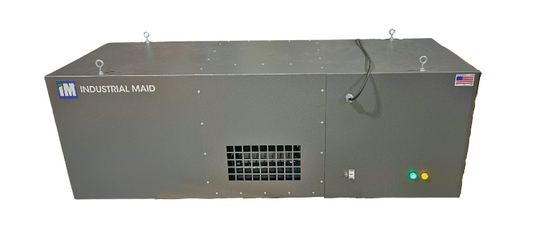
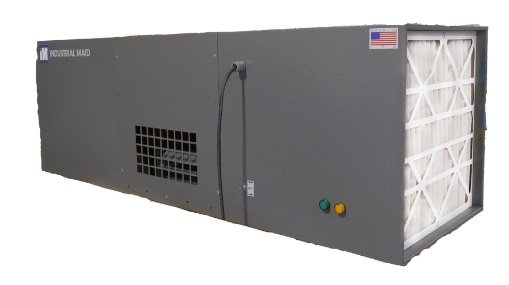
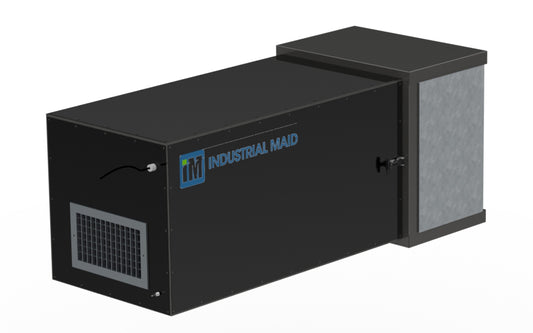
At Industrial Maid we
use the newest technology to design and
manufacture air filtration equipment
that will address the problems all
facilities with diesel fume exposures
face including space, air flow, costs,
efficiency and challenges. Another
important consideration is the type of
filters that best suit the system you
choose. Give us a call at TF:
877-624-3247 or
send us an email:
sales@industrial-maid.com. We carry
a full line of pleat, bag, and HEPA
filters so be sure to ask our staff
which would be best for your type of
application.
|