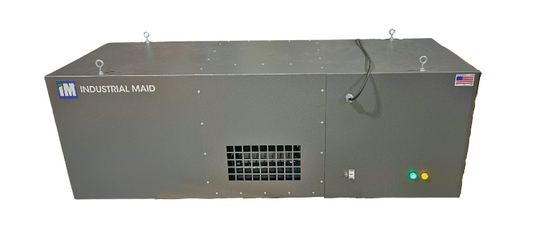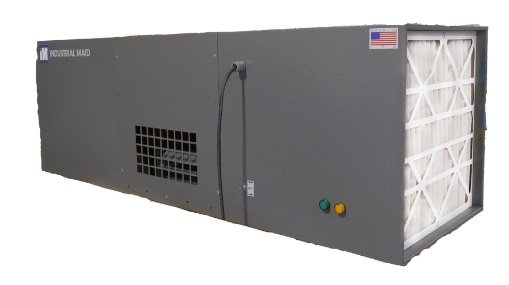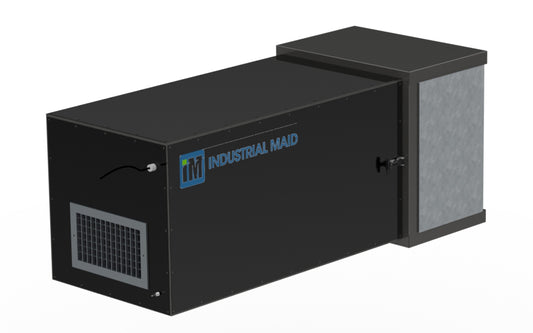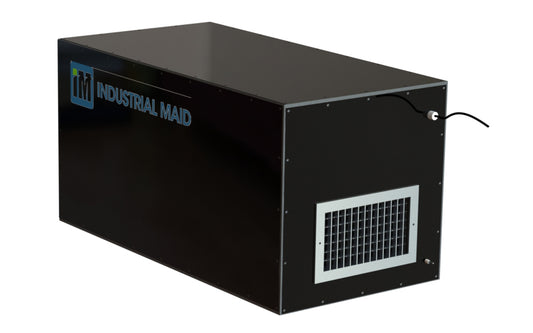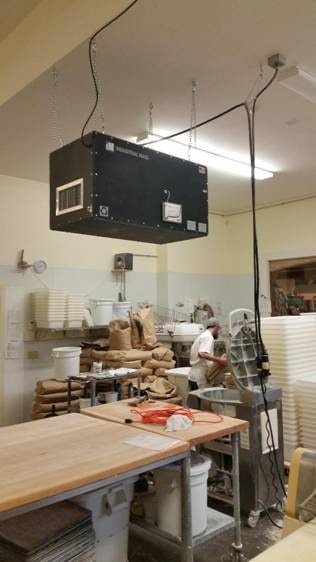
T-Series Industrial Air Cleaner Push/Pull Systems
The T-Series Push/Pull System is the most efficient and cost effective way to clean the ambient air in Industrial facilities. Here are just some of the advantages of using a T-series push/pull modular industrial air cleaner system in your plant vs. a ducted push/pull system:
1. Better Air Patterns
- Air is circulated throughout the space in several small circular air patterns, not stripped across at one level like ducted air cleaning systems. The resulting rotational air patterns act to pull smoke into the push/pull environmental air stream through centrifugal force.
- The power of the clean air/exhaust or positive side of the fan is used to force dirty air to the adjacent air cleaner’s filter intakes.
- Less dead air space than ducted systems. (see first bullet)
- Greater velocities, energy from the air cleaner’s fan is forced directly across the space, not through ducting and diffusers. Allowing you to push/pull air across greater spans in your plant.
2. No Ducting
- Allows more freedom in location
- Less expensive to install (typically no mechanical contractor required)
3. Less Maintenance
- No dust trays, dump bins or 55 gallon drums to handle
- Dust is contained inside the filters – cartridge style requires handling with the dust all lodged on the outside of the filter
- Easier to move or reconfigure as your business grows or your plant layout changes
4. Cost Efficient
- Lower capital cost to purchase
- Less hp per cfm to operate. Industrial Maid T-series push/pull systems utilize a high volume/low pressure centrifugal fan, operating at 2-3” w.g. which requires less horsepower than a similar sized industrial air purifier with ducting operating at 7-8” w.g.
- No compressed air required
- Less maintenance, no monthly dust removal - couple with VFD’s for even greater operating efficiency - Call for more info: 1-877-624-3247
5. Adaptability
- Adding more units doesn’t require removal and resizing/balancing ductwork
- Simply add the required amount of T-series that the space requires for the desired air changes per hour.
- No limits on the size of space that can be cleaned.
An Industrial Maid T-series Push/pull ambient air cleaning system is ideal for:
- Production plants industrial air cleaning
- Large space clean air system
- Weld fume control
- Applications not suitable for source capture and/or in conjunction with source capture systems
- Machine shop industrial air filtration
- Implement dealers and farm shop smog hog
- Automotive assembly air cleaning assembly
- Autobody dust and fiberglass dust in Body Shops
- Metal Fabrication industrial fumes
- Granite/Marble processing industrial air cleaner
- Diesel shops fumes extraction
- And much more!
Application Pictures Push-Pull Ventilation System
In approximately 500 indoor air quality investigations in the last decade, the National Institute for Occupational Safety and Health (NIOSH) found that the primary sources of indoor air quality problems are:
Inadequate ventilation |
52% |
Contamination from inside building |
16% |
Contamination from outside building |
10% |
Microbial contamination |
5% |
Contamination from building fabric |
4% |
Unknown sources |
13% |
Our Aztech T-Series Air Cleaners are specially designed as extensions to commercial and industrial HVAC air cleaning systems. Many of our satisfied customers are contractors who have discovered the T-Series to be a beneficial add-on product line when working with commercial and industrial manufacturers interested in filtering their indoor air. Units are available in CFM ranges of 1000 to 8000, are modular in design and can be configured to collect welding smoke and fumes, grinding dust, wood dust, oil mist, vapors and other nuisance dusts. We are proud to note that Industrial Maid is participating in the drive toward “green” building–using environmentally friendly, recycled high density polyethylene plastic for our cabinet shells.
How do you define dust in an industrial setting?
In most industrial applications the common definition of dust is air currents consisting of very small solid particles formed by impact processes such as grinding or crushing. MSHA (The Mine Safety and Health Administration) defines dust as "finely divided solids that may become airborne from the original state without any chemical or physical change other than fracture". Any given process can produce a wide range of particle size depending on the physical elements of the material itself and the way the material is handled during processing. Thanks to gravity, particles that are heavier than the air carrying them settle to surfaces. Unfortunately, particles that remain airborne are easily inhaled, thus the need for an efficient air cleaning system.
It is not uncommon to find chemical particulates in the air or on surfaces in work environments. Along with dust, fumes, smoke, mist and fog can also be considered particulate agents. Fumes are typically a result of heating metals past the melting point and smoke most often is the result of a burning process. Mist and fog are made up of liquid particles formed when liquids are broken into droplets or when water vapor condenses do to cooling.
How do you quantify dust exposure?
For identification purposes, dust is most commonly measured in microns or micrometers and for conversation regarding occupational health and safety, OSHA classifies dust into three main categories:
- Respirable Dust - Respirable Dust constitutes the highest health risk for workers. This term refers to those particles that are small enough to pass through the nose and upper respiratory system and lodge deep into the lungs. The human body has protective mechanisms like cilia and mucous designed to handle larger dust particles but when the smaller ones get passed these natural "bodyguards" they are likely to be retained in the body.
- Inhalable Dust - The EPA standard for inhalable dust is that size fraction of dust which enters the body, but is trapped in the nose, throat, and upper respiratory tract. 10 µm is approximately the median aerodynamic diameter of this dust.
- Total dust - Total dust includes all airborne particles, regardless of their size or composition.
Why should we worry about dust?
In many industrial processing applications it is a fact of science that dust particles will escape into the workplace airspace. It is when the particles become excessive that business owners need to become aware that a well-designed air cleaning system can prevent the following types of potential health and industrial problems:
- Occupational respiratory diseases
- Irritation to eyes, ears, nose and throat
- Irritation to skin
- Risk of dust explosions and fire
- Damage to equipment
- Impaired visibility
- Unpleasant odors
- Problems in community relations
- Plus many other examples
No one would argue with the statement that the health hazard to workers is the most important of the risks listed above. The American Conference of Governmental Industrial Hygienists (ACGIH) has adopted a number of standards known as threshold limit values (TLVs) in order to determine the degree of health hazard in any industrial process facility. Used as guides in the evaluation of health hazards, TLVs are time-weighted concentrations to which nearly all workers may be exposed in an 8 hour workshift - over extended periods of time - without experiencing negative health effects. MSHA also uses these TLVs for testing and enforcement of health hazard guidelines.
Is all dust bad?
It is important to note that not all types of dust that workers are exposed to produce the same degree of health risks. According to OSHA's Dust Control Handbook for Mineral Processing, the factors that determine the scope of risk are:
Dust Composition
- Chemical
- Mineralogical
Particle Size and Shape
- The particulate size distribution within the respirable range
- Fiberous or spherical
Dust Concentration
- On a weight basis: milligrams of dust per cubic meter of air (mg/m3)
- On a quantity basis: million particles per cubic foot of air (mppcf)
Exposure Time
Controlling Dust
The best method for controlling dust is the application of a few sound engineering principles. Industrial air filtration systems that significantly reduce worker's exposure to harmful dust also produce the secondary benefit of reducing downtime and equipment wear and maintenance. These three steps have been identified as proven methods for reducing employee exposure to dust:
Prevention
"An ounce of prevention is worth a pound of cure" can undoubtedly be applied to dust control in the workplace. Properly designed systems for processing materials is key in minimizing the initial generation of dust and its disbursement.
Control Systems
After all the practical preventive measures are in place, the remaining dust particulates can be controlled by one or more of the following techniques:
- Dust collection systems - Industrial ventilation equipment engineered to capture airborne dust from the source of the process and the airflow surrounding it. The captured dust is then vented to a dust collector where the dirty air is cleaned.
- Wet dust suppression systems - This technique uses liquids (usually water) to wet the material being processed so that very little of the resulting dust becomes airborne.
- Airborne Dust Capture Through Water Sprays - Here we have suppression of airborne dust by spraying fine droplets of water on the dust cloud. Dust particles that mix with the water droplets become too heavy to remain airborne and drop from the airstream.
Dilution or Isolation
In dilution the concentration of dust in a given area is reduced by diluting the contaminated air with uncontaminated fresh air. This option is most often used when circumstances surrounding the operation or process make other dust control measures impractical. When a related option for protecting a worker places them in an enclosed area bringing in clean filtered air it is called isolation.
*OSHA Technical Manual Section III:Chapter 2