|
Vertical Fume Ventilation Hood Specifications |
|
CONSTRUCTION:
12 & 14 Ga. Powder Coated Steel Frame
3/16 Polyethylene Panels
Full Carbon Steel Construction Available
11 & 18 Ga. Hood Cam Door and Filter Latches
MOTOR:
3/4 HP 115/1/60
1 HP 208/230/460/3/60 TEFC
3 HP 208/230/460/3/60 TEFC
5 HP 208/230/460/3/60 TEFC
ELECTRICAL:Wired
to Jct. Box
BLOWER:Direct
Drive BI Wheel
FILTERS:
2" Aluminum Baffle Prefilter
4" Pleated Prefilter
95% Fiberglass Bag Filter
OPTIONS:
Eyebolts
Acoustic Lining
Magnahelic Pressure Gauge
Manometer
Floor Stand
Custom Welding Hood Sizes
VOLUME:1000-6500
CFM @ .75" W.G.
DIMENSIONS:
RH36V-1 70" H x
40" W x 38" D
RH36V-IBD 80.5" H x 26" W x
25" D
RH36V-1X2 76.5" H x 66" W x 38" D
RH36V-1X3 86.25" H x 92" W x 38" D
RH36V-1X4 91" H x 118" W x 38" D
RH36V-2x2 76.5" H x 66" W x 61.5" D
RH36V-2x3 91" H x 92" W x 62" D
WEIGHT:
534-1350 lbs.
* Efficiencies are based on
ASHRAE test methods.
|

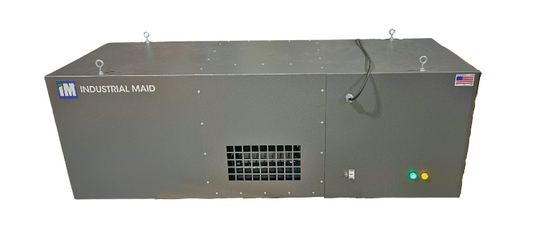
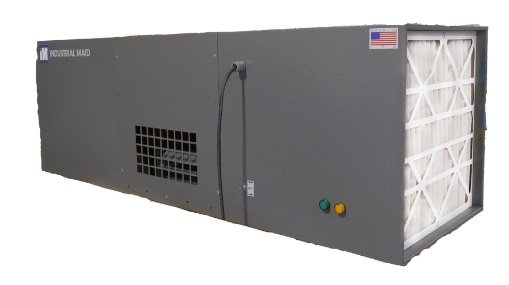
RH36V-1X2
INDUSTRIAL MAID
RHV SERIES - WELDING VENTILATION HOODSIndustrial Maid
introduces the new RHV welding hood – a
complete packaged welding smoke and fume hood for industrial air
filtration. The units can be configured to cover areas from 4’ X 4’ to
16’ X 16’ or larger if needed. A three stage filter system includes the
baffle filter, 4” pleated filter (Merv) and a 95% multi-pocket main bag
filter (Merv). These filters will handle oily weld smoke and options
are available to include a final HEPA filter for stainless steel or
other applications requiring higher efficiency filtration.
The RHV
ventilation hood series incorporates a low static pressure motor blower
package, require no compressed air and no handling of dust from trays or
drums. The resulting fume extractor efficiency translates into an economical solution
for handling welding smoke and fumes; dollars saved as a direct result
of controlling utility costs.
|
AZTECH
RH36V-1 |
1,600 CFM |
 |
|
AZTECH
RH36V-IBD |
1,600 CFM |
 |
|
AZTECH
RH36V-1X2 |
2,000 CFM |
 |
|
AZTECH
RH36V-1X3 |
3,300 CFM |
 |
|
AZTECH
RH36V-1X4 |
4,500 CFM |
 |
|
AZTECH
RH36V-2X2 |
3,500 CFM |
 |
|
AZTECH
RH36V-2X3 |
4,500 CFM |
 |
(Note: links to
specifications and spec drawings will open in a new browser
window for a more printer-friendly document) |
|
|
Horizontal
Industrial Ventilation Hood Specifications |
|
CONSTRUCTION:
17,10,14 & 16 Ga. Powder
Coated Steel Frame
Powder Coated Steel Cabinet
3/16 Polyethylene Panels Available
4-way Aluminum Exhaust Grille
20 Galv. Steel Hood
MOTOR:
3/4 HP 115/1/60
2 HP 208/230/460/3/60 TEFC
3 HP 208/230/460/3/60 TEFC
5 HP 208/230/460/3/60 TEFC
ELECTRICAL:Wired
to Jct. Box
BLOWER:
3/4 HP - Direct Drive
2 & 3 HP - Belt Drive
3 & 5 HP - Direct Drive High Pressure
FILTERS:
2" Aluminum Baffle Prefilter
4" Pleated Prefilter
95% Fiberglass Bag Filter
OPTIONS:
HEPA After Filter
Silencer
Magnahelic Pressure Gauge
Fluorescent Light Kit
6" AZTech Orange Strip Curtain
VOLUME:3000-6500
CFM @ .75" W.G.
DIMENSIONS:
3500
RH35-3 36.5" H x 87.5" W x 134"
D
RH35-4 36.5" H x 112" W x 134" D
RH35-5 36.5" H x 136.5" W x 134"
D
6000
RH60-3 36.5" H x 87.5" W x
144" D
RH60-4 36.5" H x 112" W x 144" D
RH60-5 36.5" H x 136.5 W x
144" D
WEIGHT:
700-1175 lbs.
* Efficiencies are based on
ASHRAE test methods.
|
|
|

RH35X3 |

RH60-4X2 |
|
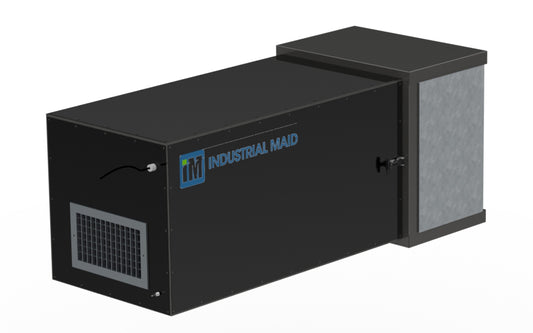
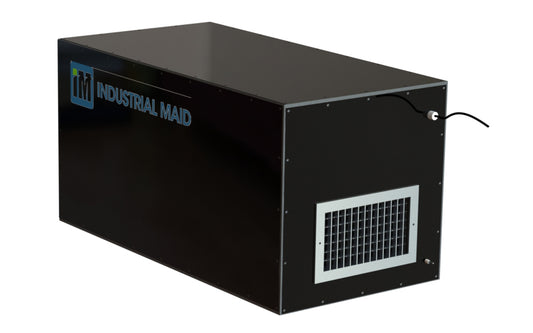
INDUSTRIAL MAID RH
SERIES - WELDING VENTILATION HOODS
Industrial Maid introduces a full line of Robotic Welding
Ventilation Hoods – in airflow ranges of 1,000 CFM to 10,000 CFM. The
unique systems have a steel fabricated cabinet, easy access filter
service doors and a
three stage filter
combination. The inlet filter is
a washable baffle filter, the pre-filter is a Merv 7 pleated filter and
the final filter is a multi-pocket Merv 13 filter bag. A final HEPA
filter is available for stainless steel welding (to control hexavalent
chromium). The product has been tested and proven to handle both dry and
oily welding fume collection applications. The units are energy
efficient, simple to service and offer a “low cost of ownership”. No
dust trays or dump bins are necessary and the units do not require any
compressed air. For more information on our performance guarantee and
available sizes to meet your specific welding smoke cell application needs
call TF:877-624-3247.
|
AZTECH RH3500 |
3,500 CFM |
 |
|
AZTECH
RH6000 |
6,000 CFM |
 |
(Note: links to specifications
and spec drawings will open in a new browser window for a more
printer-friendly document) |
The Positioning of Welding Fume
Exhaust Systems
Otherwise known as "Location, Location, Location" |
The key to keeping workers safe from the dust,
smoke and fumes that enter environmental air as a result of many industrial
processes, is to capture the air with it's suspended particulates, before it is
inhaled. After investing precious time
and money on welding fume exhaust systems, many business owners and safety
managers would be alarmed to know that the majority of their workers are still
breathing in harmful fumes.
A tour of too many manufacturing
plants would find a frighteningly high number of
source capture arms either suspended above
the welder's head or too far away from the source to be effective. If you
stop to think about angles and airflow, a fume extractor hanging above a
worker's head, could actually be pulling the weld fumes straight into his face
and airspace.
3 Critical Pieces to
Achieving Proper Source
Capture of Welding Fumes are:
|
1) An easily positioned fume extractor with a
well-designed industrial ventilation hood.
As we all know heat rises, so the welding smoke, fumes and particulates
created by the heat of a welding arc naturally travel upwards above
the weld. Since the purpose of a fume extraction hood is to
prevent fumes from entering a welder's breathing space, proper
positioning of the ventilation hood should be of primary consideration.
The operator should make sure that the fume extractor is located
above the weld and opposite him/her, effectively drawing the fumes
out of the breathing space.
|
2) Proper airflow through the fume extractor.
| In most
cases industrial fume hoods should be located within the distance of two
hood diameters from the source of the fume smoke. However the final
location should be determined only after careful analysis of variables
such as the amount of airflow passing through the welding fume
collector, the overall movement of air in the workspace and the specific
design of the hood. The most effective ventilation hood pulls in
air from every direction so it is important to remember that the
velocity of the moving air decreases sharply as you move away from the
hood opening as illustrated in the diagram to the right. The
American Conference of
Governmental Industrial Hygienists (ACGIH) offers the table below to
illustrate the airflow formula for determining the
capture velocities of some common hood designs.
The most commonly recommended air velocity across the welding area is in
the range of 100 ft./min. Higher velocities may compromise the
shielding gas around
the weld material. |
 |
|
Hood Type |
Description |
Aspect Ratio. W/L |
Airflow |
 |
Plain Opening |
0.2 or Greater
and Round |
Q =V (10X2+A) |
|
Flanged Opening |
0.2 or Greater
and Round |
Q =0.75V (10X2+A) |
|
Flanged Multiple Slot Opening 2 or More
Slots |
0.2 or Greater |
Q =0.75V (10X2+A) |
|
Q = Volumetric airflow(cfm)
V =
Centerline air velocity(fpm) A
=
Area of hood opening
X = Distance from hood
to source of the fumes |
|
The concept that "more is better" does
not necessarily apply here. Many times those in charge of
selecting a industrial ventilation hood system assume that very
large volumes of air, or CFM, are necessary for optimum fume
exhaust. Using industrial fume hood design and air volume to determine the
correct CFM required for any given application prevents wasting
money by over heating and cooling plant air.
The most common
formula to calculate
how much airflow is required is
Q =V (10X2+A).
For example, a welding
application with a 6" diameter plain-opening round hood that requires
100 fpm at the welding zone would require 1020 CFM if the fume
ventilation hood is
placed 12" from the weld area.
- Q = 100 fpm [10(1 ft.)2
+ 0.196 ft.2]
- Q = 1020 cfm
The same hood
placed 8" from the source however would only require 464 CFM.
- Q = 100 [10(8/12)2
+ 0.196)]
- Q = 464 cfm
Because the airflow pattern is different for each
style of industrial ventilation hood, it is a good idea to use the same steps and formula to determine
which is most efficient design for a given process.
3) Training welders to position the hood properly
The calculations above are simple
but eye-opening examples of how moving a fume extractor just 4" closer to the
fume source can mean the CFM required to maintain 100 fpm is reduced by more
than 50%. It is vitally important that welders be trained in the importance of
keeping welding fume collectors in the proper position in order to maximize the
safety of their work environment and their health. |